
The conference ended three weeks ago. The conversations haven’t.
I’ve had more follow-up discussions about apidays Singapore 2026 than any previous edition — which tells me the themes landed differently this year. Over two days at Marina Bay Sands, more than 100 speakers and 1,500+ attendees worked through a single question that kept surfacing in every session and every hallway conversation: what does it actually take to build for the era of autonomous AI agents?
The official theme was “The Execution Layer: Building APIs for the Agentic Era.” As Mehdi Medjaoui noted in his opening remarks, the apidays community has been connecting the humans behind APIs for 14 years — and this year’s conversation felt like a genuine inflection point.
Here are the five ideas I keep coming back to. Not a summary of every session, but the threads that have kept running through conversations in the weeks since.
1. Your API Consumer Has Fundamentally Changed
Aki Ranin opened the conference with a keynote titled “How to Connect AI Agents to Your Business” — a question that sounds simple until you think it through carefully.
AI agents don’t behave like developers. They don’t navigate your developer portal, read your documentation, or raise a support ticket when confused. They parse your OpenAPI specification in real time and infer everything they can from what’s there. If your spec is incomplete, inconsistent, or ambiguous, the agent doesn’t ask for clarification. It makes a wrong decision — silently, at scale.
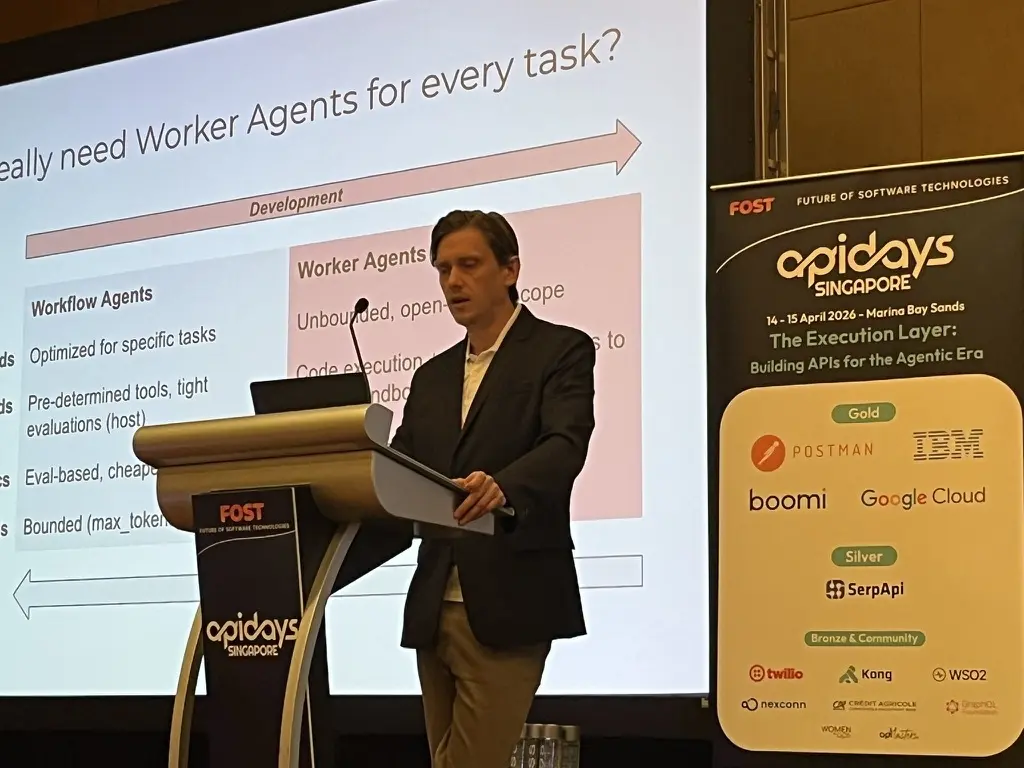
“Your business will run on agents. Who has the red button? Can somebody just turn your agents off? Imagine what that looks like — it’s as if somebody told your employees this morning: do not come to the office.”

Aki’s taxonomy of agents — prompt agents, workflow agents, and worker agents — gave the conference a shared vocabulary that surfaced in sessions across all five stages. His argument: most organisations are still thinking about “chat” as the end state. The real shift is to worker agents that execute, not just respond. And that shift demands a fundamentally different relationship with your API infrastructure.
The sovereign AI argument he closed with is worth sitting with independently. The organisations that treat agent infrastructure as a strategic asset — understanding who controls the models, the compute, and the deployment layer — are the ones that will maintain optionality as the geopolitical and commercial landscape around AI continues to shift.
2. Governance Determines Whether Your AI Initiative Reaches Production
The starkest warning of Day 1 came from Ram Tallavajhala, Innovation & Strategy Architect at Boomi. His session — “From Pilot to Production: Why API Governance Determines Agentic Success” — named a failure pattern that is playing out across the industry right now.
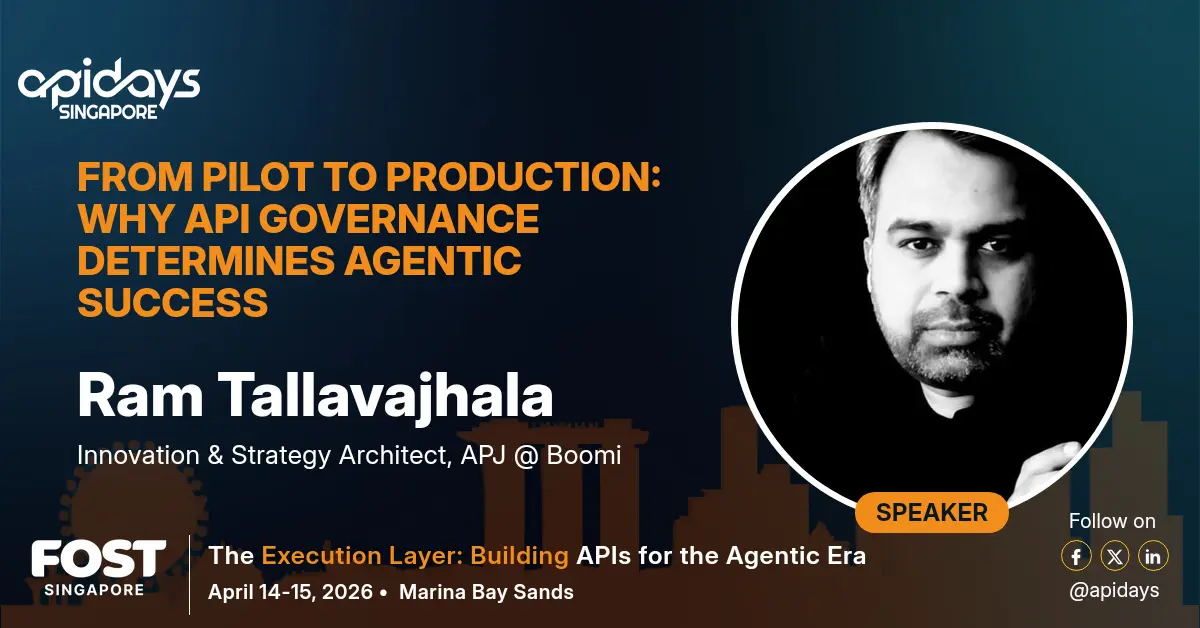
Ram called it the “wipe coding effect.” AI coding tools accelerate delivery dramatically — but when governance is skipped under board pressure to ship, the resulting tech debt compounds fast. A badly documented API becomes a pattern. The pattern becomes a behaviour. The behaviour becomes a standard. Then you put a probabilistic agent layer on top.
“What we accumulated as tech debt over decades can now be accumulated in 2 months. Once you start putting agents on top of a badly governed API layer, it amplifies a lot because of that probabilistic nature.”

The data Ram cited should be on every CTO’s slide: 73% of companies expect agents in production, but only 2% of those agents are actually accountable — meaning you can’t trace what they did or why.
His counter-intuitive advice: “You need to have a brake for a car to make it go fast. Perceived speed is not actually sustainable velocity.” The organisations getting agentic AI right are investing in governance now, so the agent layer goes up on a clean foundation rather than an amplified mess.
The governance anti-patterns Ram sees most in the field: governance theater (lots of meetings, no enforcement), API catalogs with no metadata, and versioning chaos. All three are solvable with engineering discipline — none of them require a large budget.
3. The Reference Architecture Exists — and It’s Being Used
Claudio Tagliabue, IBM’s Field CTO (Automatioin) for Asia Pacific, presented what became the most-photographed slide of the conference: a complete reference architecture for enterprise agentic AI.
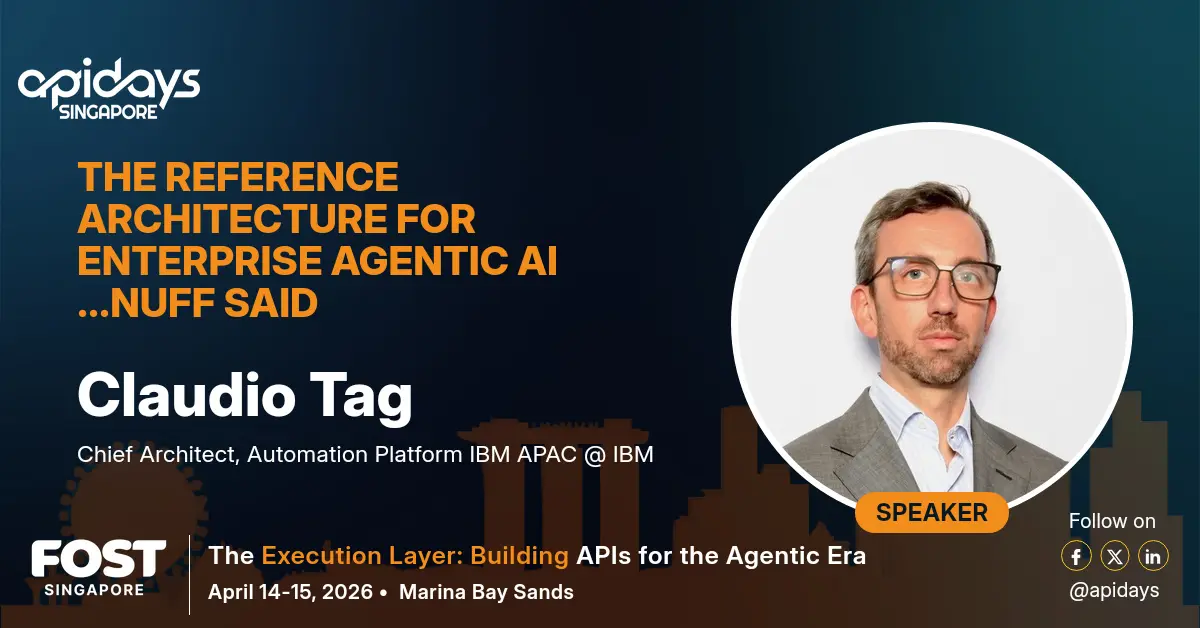
His session title — “The Reference Architecture for Enterprise Agentic AI …nuff said” — turned out to be accurate. Rather than another set of conceptual frameworks, Claudio put something concrete and reusable on screen: the architecture you actually need to build agentic AI responsibly at enterprise scale.
The core argument: agents are exciting, but they carry non-functional limitations that pure probabilistic systems can’t resolve. The answer isn’t to choose between agents and traditional automation. It’s both.
“Don’t refactor your IT estate. Don’t rip out your APIs and rebuild them in MCP. Compose your existing tools instead. Think of them as the deterministic layer that agents use to act reliably — while the agent handles the creative reasoning.”

The architecture distinguishes three orchestration layers: agent orchestration (multi-agent coordination), tool orchestration (a single agent sequencing tools to complete a workflow), and what Claudio calls “backend for agents” — the deterministic layer that wraps your existing integrations so agents can consume them without burning context on data mapping.
His practical dos and don’ts are worth keeping close: don’t hardcode deterministic workflows into agents. Don’t focus only on models. Think about identity and security from day zero. Have circuit breakers ready. And on gateway sprawl — his advice was direct: demand a unified approach from your vendor rather than accumulating point solutions.
We’ve published a full deep-dive on Claudio’s reference architecture as a standalone piece. Read it here: [LINK TO ARTICLE 2 — update once published].
4. Developer Creativity Is the New Yardstick for Engineering Excellence
Manjunath Bhat’s keynote — “Future of Software Engineering 2030: The Impact of AI” — did what his sessions consistently do: recalibrate the room’s sense of where the industry actually is, grounded in Gartner research data.
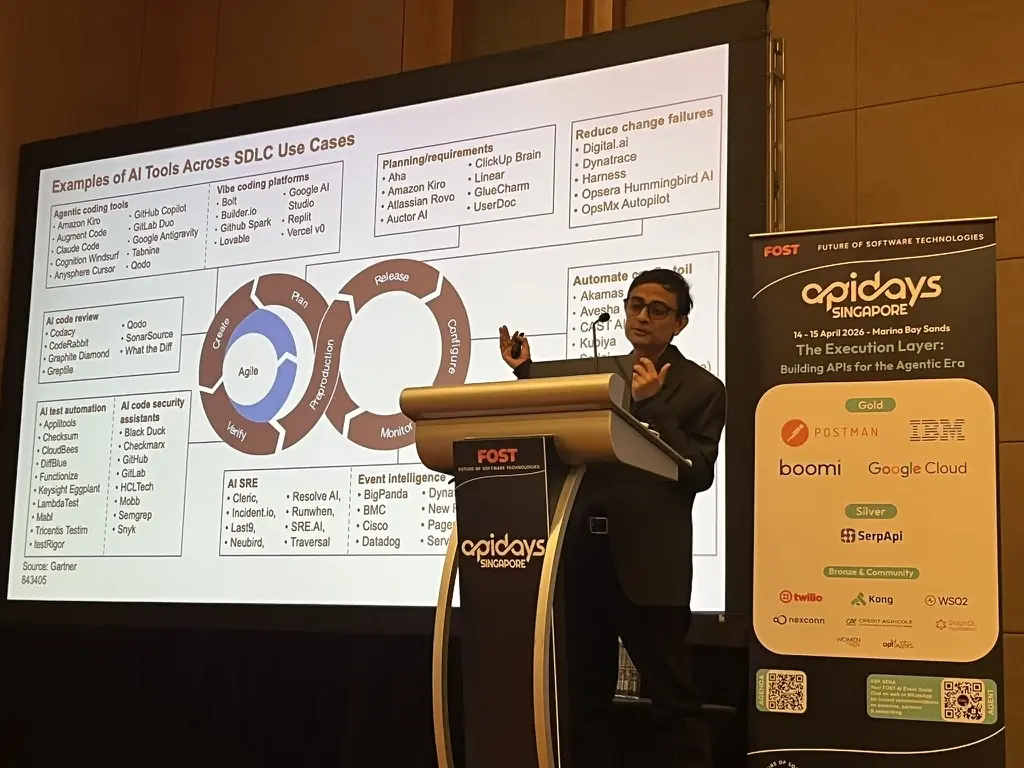
His counter-intuitive headline: the industry will need more developers, not fewer. AI will fuel demand. Every organisation using AI to ship software faster will need to continuously differentiate to maintain competitive advantage — a virtuous cycle that increases, rather than decreases, the need for engineering capability.
But what developers are valued for is shifting:
“Execution is going to be commoditized. What’s going to be extremely significant is executive function.”

Manju’s framework for the organisations succeeding in 2026: tiny teams (a product owner, a designer, an engineer, complemented by agents), supported by platform teams that provide intelligence as a service. Eval-driven development replacing test-driven development. Spec-driven development as the mechanism that brings rigour to what he calls “vibe coding.”
His closing question is still worth sitting with: “What would you build if you could build anything?” The cost of building software is collapsing. The question of why we build, for whom, and to what end — that becomes the human advantage.
5. The Human Side Is Where Most AI Transformations Actually Fail
The Stage 2 panel — moderated by Akhil Bhaskar (AWS) and featuring Alberto Resco Perez (Singtel), Manish Hemani (Oliver Wyman), and Keith Carter (KDA Capabilities) — was one of the more direct conversations at the conference.
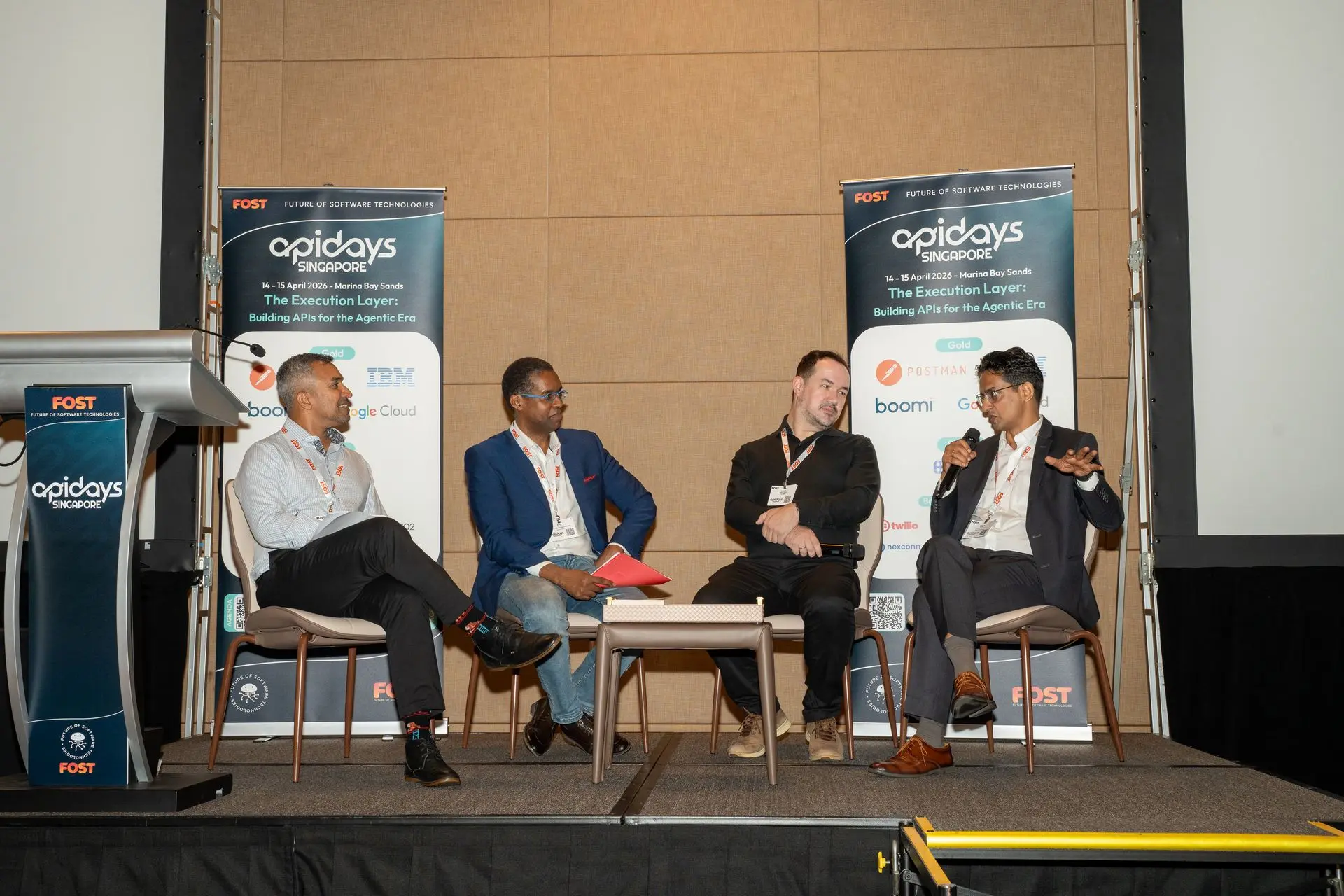
Keith Carter’s “reskill, redeploy, let go” framework named the leadership conversation most organisations are avoiding. Some people are reskillable because they’re curious. Some are redeployable because their skills have adjacent value. The kindest thing leaders can do, Keith argued, is have the honest conversation early rather than creating false hope.
Alberto Resco Perez flipped the common framing: “I try to flip around on the senses. If you give everybody AI tools, how fast can we become? I don’t want to do 100% with 70% — I want to do 150% with 100%.” The leadership question isn’t ‘how do I cut?’ It’s ‘how do I go faster?’
Manish Hemani added a warning worth noting: model homogeneity risk. If every financial institution uses the same few models and a systemic market shock occurs, they all receive the same answers at the same time. He cited the Bretton Woods Committee’s work on this as an emerging systemic risk in financial services.
Keith’s closing line on governance was the one that stayed with me longest: “Governance is cultural. Every model’s changing. How do you govern the next model? It’s not from last quarter’s board meeting — it’s today.”
What Comes Next
These five themes are the starting point, not the summary. Over the next three months, The Loop Asia will be going deeper on each of them — through long-form articles and podcast conversations with the speakers who built the ideas.
Next in this series: a full deep-dive on Claudio Tagliabue’s reference architecture for enterprise agentic AI — the session that generated the most follow-up questions. Read it here: Why Your Existing APIs Are the Answer, Not the Problem.
If any of these themes are live strategic questions in your organisation — what AI-readiness actually requires, how to sequence investments, where governance needs to start — the note below is for you.
Is your leadership team ready for the agentic era?
The Blue Connector Executive Lunch & Learn is a 90-minute session for C-suite leaders on what AI-readiness actually requires — without the hype. Real examples from financial services, government, and enterprise technology across Asia-Pacific.
Jon Scheele is the founder of Blue Connector and local partner for apidays Singapore. He hosts The Loop Asia podcast and has worked at the intersection of APIs, integration, and enterprise technology in Asia-Pacific for over a decade.
Connect on LinkedIn: linkedin.com/in/scheelejon
Learn more at: https://www.blueconnector.co/ai-readiness
Conversations on technology leadership across Asia-Pacific
The Loop Asia covers AI, APIs, and digital transformation with practitioners doing the work. Subscribe for new episodes and articles.
Subscribe to The Loop Asia